Best Drum Practice Pads: Choose the Right Size and Feel
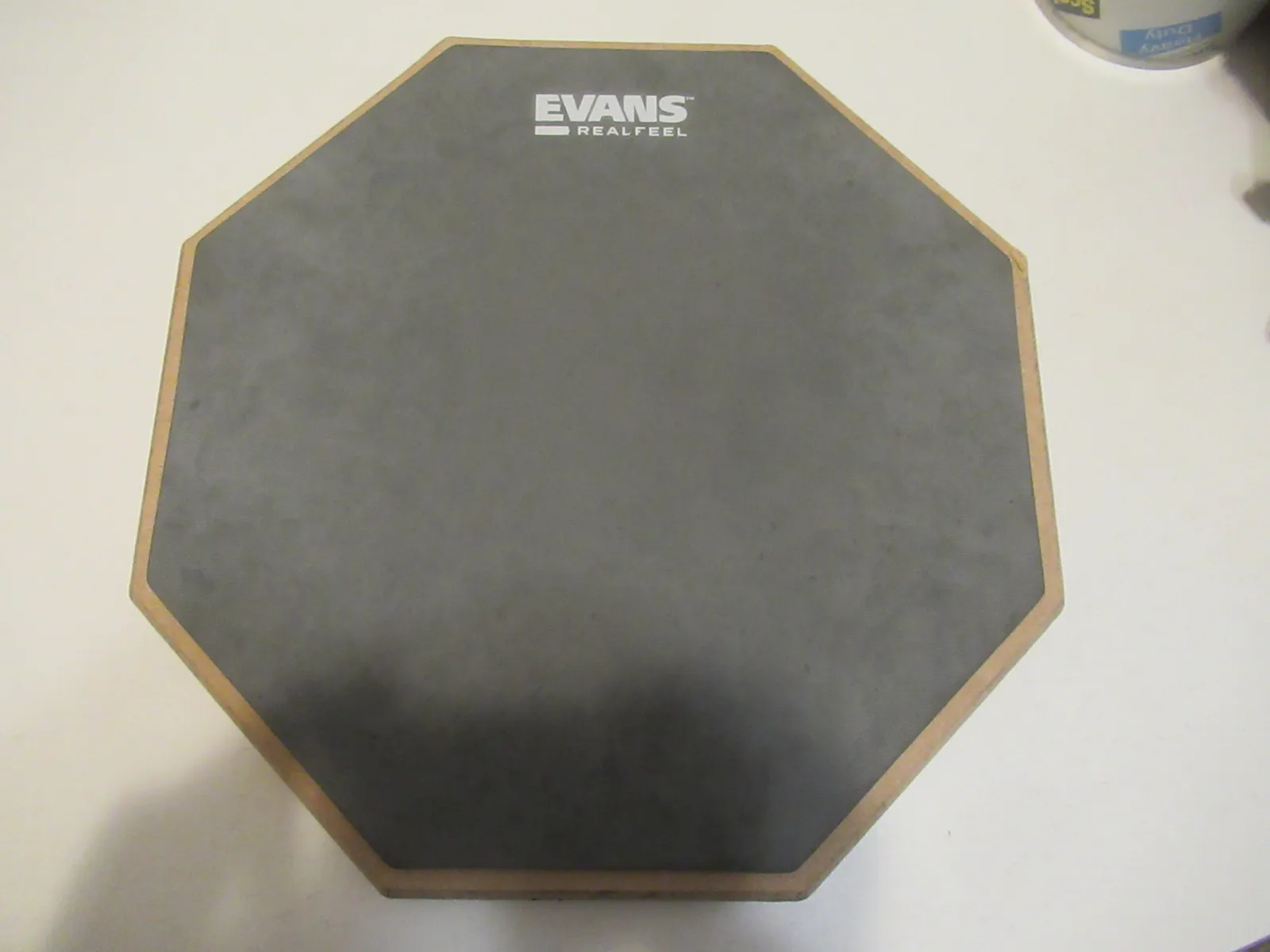
Most people shopping for a practice pad want one thing first: a quieter way to practice their hands at home. The pad you should buy mostly comes down to size, rebound (how much the stick bounces back to you), and where you can set it up. For a first pad, the EVANS RealFeel 12-inch (RF12D) is our default; the 6-inch version (RF6D) is the same idea when it needs to fit in a bag, and the specialist surfaces below earn their place for quiet rooms or low-rebound work.
As an Amazon Associate I earn from qualifying purchases. If you buy through our Amazon links, we may earn a commission at no extra cost to you. Product names in the table link to the official maker pages; the Amazon links are separate “check price” actions.
| Pad | Best when | Main surface | Support check |
|---|---|---|---|
| EVANS RealFeel 12-inch (RF12D) | You want a full-size everyday first pad | Two gum/recycled rubber sides | Sits on a solid surface; check snare basket fit before assuming it will grip |
| EVANS RealFeel 6-inch (RF6D) | The same idea has to disappear into a backpack | Two gum/recycled rubber sides | Use a supported table; check actual stand fit |
| Vic Firth 12-inch PAD12D | You want a firmer hard-side feel with more articulation | Softer gray side plus harder black side | Vic Firth says it fits most snare stands, not all |
| Remo Silentstroke 8-inch RT-0008-SN | You want a tunable mesh surface | Mesh head over a base | Rubber table base; stand use needs a compatibility check |
| RTOM Moongel 7-inch | You want supplemental low-rebound work | Low-rebound gel surface | 8mm stand connection; rubber base for tabletop use |
EVANS RealFeel 12-inch (RF12D): the everyday starting pad
The EVANS RealFeel 12-inch (RF12D) is the pad we’d point most first-time buyers to first. It gives you two rubber surfaces in one purchase: one natural gum rubber side and one recycled rubber side. That means you can change the response without buying a second pad or swapping parts.
The nominal 12-inch size is not a guaranteed footprint for your desk or music stand. The actual base and outer shape can take up more room than the number suggests, especially on a narrow shelf. If you want it at drum height, plan for a stable table or a snare stand with a basket that will actually grip the pad’s edges. This pad does not promise a threaded screw mount, so don’t assume you can attach it to any cymbal stand.
Check the EVANS RealFeel 12-inch price on Amazon
The 6-inch option (RF6D)
The EVANS RealFeel 6-inch (RF6D) is the same two-sided idea in a smaller size. Its main advantage is simple: it fits in a backpack, a tour bag, or a crowded practice drawer. The tradeoff is a smaller striking area. That’s fine for focused single-surface hand work, but less forgiving if your strokes drift.
A small pad still needs a supported surface. Put it on a sturdy table at a height that doesn’t force you to hunch, or use a stand that actually fits. Don’t assume the 6-inch model fits a conventional snare basket or has a screw socket. Check before you buy a separate mount.
Check the EVANS RealFeel 6-inch price on Amazon
Vic Firth PAD12D: a firmer hard-side option
The Vic Firth 12-inch PAD12D is worth a deliberate look when your practice goal is clean articulation rather than a generic first pad. Vic Firth’s product page describes a softer gray rubber side and a harder black side with quicker rebound and more articulation and volume. That harder side can make fast patterns feel more defined under the stick.
The wooden base and 12-inch size make it a natural partner for a snare basket, but “most snare stands” is not the same as “all.” Check your stand’s grip range before ordering.
Check the Vic Firth 12-inch PAD12D price on Amazon
Remo Silentstroke 8-inch RT-0008-SN: a tunable mesh option
For a quieter-surface practice pad, the Remo Silentstroke 8-inch RT-0008-SN is a complete tunable mesh pad. Because you can adjust the tension of the mesh, the response changes without buying a second surface. That’s the main reason to choose it over a fixed rubber pad.
Remo gives this model a rubber tabletop base, and the product page also covers stand use, but no specific thread size is stated here. If you plan to mount it, verify the connection before you buy an adapter.
One naming trap matters. The RT-0008-SN is the complete pad. The similarly named PH-0008-SN is a replacement mesh head, not the pad. Make sure you’re ordering the full model, especially if you’re searching by name rather than clicking from the official page.
RTOM Moongel 7-inch: a supplemental low-rebound workout
The RTOM Moongel 7-inch is the pad you buy when you want the stick to do less of the work. RTOM describes the gel surface as having very low or no free rebound, which means the stick doesn’t bounce back on its own. Your hand has to produce the next stroke.
That is useful for deliberate control work, but it is not automatically better for a first pad. Normal rebound teaches you how the stick responds and gives your touch a reference point. If you remove that bounce before you’ve learned it, you can make early practice harder without making it more effective. This is a sensible second surface, not a replacement for an everyday pad.
The Moongel has an 8mm stand connection if you want to mount it, plus a rubber base for tabletop use. Don’t confuse it with RTOM’s DBS dual-sided pad or with Moongel damping gels, which are a different product for drumheads.
6 vs 12, room, and mounting: the practical decision
Size usually matters more for where the pad lives than for what you can practice. A 12-inch pad gives you a larger striking area and tends to be easier to hold in a snare basket, but it takes up real space and is less travel-friendly. A 6-inch pad disappears into a bag, but it asks more of your accuracy and more of your setup surface.
There are two common ways to support a pad. A snare basket is the three-arm clamp at the top of a snare stand; it grips the edges of a drum or pad. A threaded mount is a screw socket underneath the pad, and it only works when the pad has the matching thread. The RTOM Moongel explicitly lists an 8mm connection; the other pads above do not promise a thread. Before buying a stand, check which system your pad actually uses.
A quiet surface is not the same as a quiet room. Stick impacts still make contact noise, and vibration can travel through a table or floor into the next room. If you practice in an apartment or after bedtime, put the pad on a folded towel, a soft mat, or a padded surface.
You don’t need a full accessory kit to start. One pair of sticks you already like, a stable surface, and a metronome app on your phone are enough for a first session. A simple ten-minute routine—five minutes of single strokes, then five minutes of double strokes—lets you test the pad without overcomplicating the purchase.
What a pad won’t do is replace a full kit. It covers hand patterns and timing, but it doesn’t reproduce pedals, drum and cymbal movement, or the coordination of sitting behind a real setup. If you’re trying to decide between a pad and a full practice option, our acoustic vs electronic drums guide walks through that boundary. And if you’re adding this to a larger first purchase, our look at the real cost of a kid’s first kit shows where sticks, stands, and thrones add up.
Method and limits, October 19, 2026
This is a research-led comparison, not a hands-on test. We reviewed the current official product pages for the exact models above and verified the linked Amazon listings by SKU, but we did not measure noise, rebound speed, durability, or side-by-side feel. Where a manufacturer describes a surface as harder, faster, or more articulate, that is their claim, not our observed result.
Specs and bundles change, and the exact support fit depends on the stand and table you already own. Check the linked official page and your own hardware before ordering. There is no measured “quietest” or “fastest” winner here—just a set of task-based choices tied to size, rebound, and where you can actually practice.