The TAMA Iron Cobra 200 HP200PTW is a single-chain double pedal built around Tama's offset Power Glide cam and Spring Tight adjustment, with a dual-sided felt/nylon beater.
Best Double Bass Pedals for Layout, Handedness, and Adjustments
Before you compare pedal brands, check two things on the floor in front of you: which foot the main pedal needs to sit under, and whether your bass drum, practice pad, or e-kit tower can actually accept two beaters striking one target. If that layout works, the pedal decision becomes about the adjustments you’ll actually use, not a speed label. If it doesn’t, a higher-priced double pedal won’t fix it, and a serviceable single pedal may be the better call. This guide covers four current right-footed double assemblies from Tama, Pearl, DW, and Yamaha.
As an Amazon Associate, we earn from qualifying purchases.
All four shopping photos reference right-footed full double assemblies. Left-footed readers should confirm the exact left-oriented model and listing before ordering.
Fit the floor.
Choose the controls.
Check handedness, both beater contact points and hi-hat clearance before choosing a double pedal.
The Pearl P-932 Demonator is a longboard double pedal on a single chain, with a two-position PowerShifter, Click Lock spring, and a Control Core Duo Beater that gives you two striking surfaces.
The DW 3000 DWCP3002A is the current double-chain A-generation 3000 pedal, with an Accelerator cam, swivel toe clamp, and 2-way DW101 beaters with memory locks.
The Yamaha DFP-9C is a double-chain pedal with a 3-position cam, independent beater and footboard angle adjustment, weight-adjustable beaters, and an auto-lock spring.
Product prices and availability are accurate as of the date/time indicated and are subject to change. Any price and availability information displayed on Amazon.com at the time of purchase will apply to the purchase of this product.
CERTAIN CONTENT THAT APPEARS ON THIS SITE COMES FROM AMAZON. THIS CONTENT IS PROVIDED ‘AS IS’ AND IS SUBJECT TO CHANGE OR REMOVAL AT ANY TIME.
| Product | Drive | Verified adjustments/controls | Choose when | Reference orientation |
|---|---|---|---|---|
| TAMA Iron Cobra 200 HP200PTW | Single chain, offset Power Glide cam | Spring Tight, beater angle adjust, dual-sided beater | You want controls at the current total without buying by a speed label | Right-footed reference |
| Pearl P-932 Demonator | Single chain, Demon Style Longboard | Two-position PowerShifter, Click Lock spring, Duo beater, adjustable shaft | You want more footboard space and will try your actual shoe | Right-footed reference |
| DW 3000 DWCP3002A | Dual chain, Accelerator cam | Footboard angle, Delta stroke, 2-way beaters | You want current documented controls and your own feel | Right-footed reference |
| Yamaha DFP-9C | Dual chain, 3-position cam, included belt conversion | Independent beater and footboard angles, weight-adjustable beater, auto-lock spring | You’ll actually use independent angles or try the belt option | Right-footed reference |
TAMA Iron Cobra 200 HP200PTW
The TAMA Iron Cobra 200 HP200PTW is a single-chain double pedal built around Tama’s offset Power Glide cam and Spring Tight adjustment, with a dual-sided felt/nylon beater. The main beater angle is coupled to the footboard angle, while the remote beater has its own fine adjustment, so don’t expect fully independent angles on both sides. Tama’s Cobra Coil CC900S is compatible but not included; it’s a separate optional accessory under the footboard. Choose this if you want those controls without paying extra for a speed-focused name.
Pearl P-932 Demonator
The Pearl P-932 Demonator is a longboard double pedal on a single chain, with a two-position PowerShifter, Click Lock spring, and a Control Core Duo Beater that gives you two striking surfaces. The Perfect Circle cam includes a removable orange eccentric, and the universal joint has length and position adjustment. A longer board is useful if your actual shoe feels cramped on a standard board, but it’s not proof of speed and not a requirement for heel-toe or metal playing. Buy the right-footed P932, not the P931 conversion kit or P930 single pedal, which are different products.
DW 3000 DWCP3002A
The DW 3000 DWCP3002A is the current double-chain A-generation 3000 pedal, with an Accelerator cam, swivel toe clamp, and 2-way DW101 beaters with memory locks. It adds Delta stroke adjustment, steel base plates with anti-skid rubber, and an included drum key. Don’t confuse this with the older DWCP3002 Turbo generation; the current reference is the A model. Choose it if you want current documented controls and your own feel underfoot without assuming an extra chain buys speed.
Yamaha DFP-9C
The Yamaha DFP-9C is a double-chain pedal with a 3-position cam, independent beater and footboard angle adjustment, weight-adjustable beaters, and an auto-lock spring. Yamaha’s current package includes belts, so you can convert from chain to belt without buying a separate retrofit kit, and it also includes a semi-hard case and a secondary anchor for the remote pedal. Choose it if you’ll actually use independent angles or try the belt conversion instead of paying for a faster-feet promise. The left DFP9CL and the direct-drive DFP9D are separate models.
Do you need two footboards?
A double bass pedal does not mean two bass drums. It means two footboards and two beaters aimed at one compatible target. The main pedal holds both beaters, and the remote pedal on the left, or mirrored on the right for left-foot lead playing, actuates one beater through a linking shaft.
You buy one when the musical patterns you want to play use both feet, not because the hardware itself will make either foot faster. If your current single pedal is serviceable and your patterns don’t demand a second footboard, keep it and put the money elsewhere. If you’re still deciding, the single bass pedal guide covers the one-foot choice in more depth.
Handedness from the player’s view
Read orientation from where you sit, not from a product photo. In a standard right-footed double pedal, the main unit sits under your right foot and carries both beaters. The remote sits further left, connected by the shaft, and drives one of them. Your hi-hat pedal goes further left again.
If you play the other way, you need a mirrored layout, not a reversed photo. Tama lists the HP200PTWL, Pearl the P932L, and Yamaha the DFP9CL as separate left-oriented references. Don’t assume you can flip a right-handed pedal or convert it with a parts swap. Buy the orientation your feet actually use.
Layout, hi-hat legs, and shaft room
Once both feet are accounted for, look at the floor around the target. The main pedal clamps to the bass drum or kick tower. The remote pedal sits off to the side and must link to the main unit through the shaft without fighting your hi-hat stand legs or your left foot’s travel.
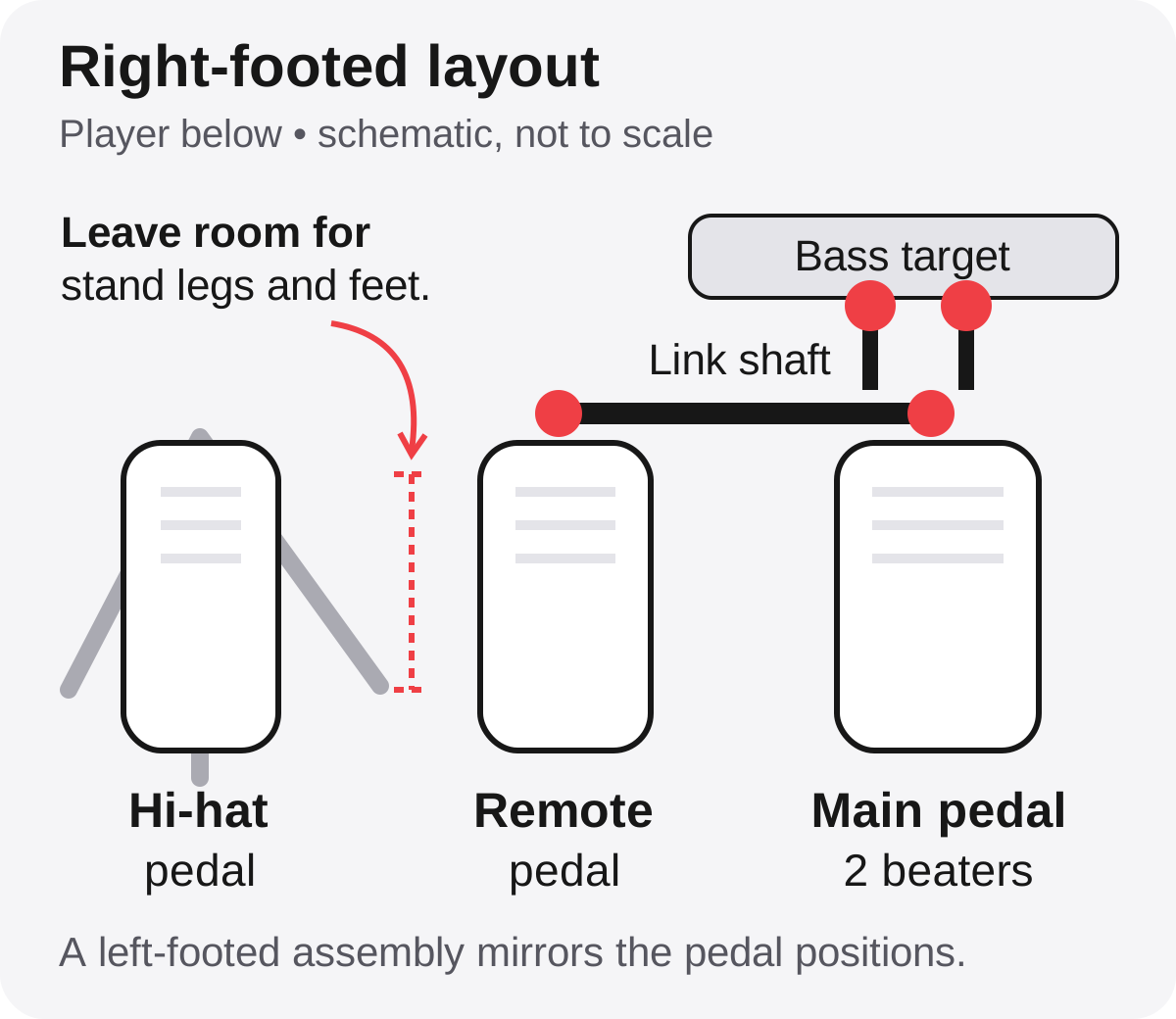
Generic overhead schematic of the right-footed double pedal layout.
The drawing above is a layout map, not a measured fit certificate. The main pedal carries both beaters and strikes one compatible target. The remote pedal links mechanically to the main unit and actuates one beater. The hi-hat pedal sits further left still. Any hi-hat leg arrangement can crowd that space, so check your own stand legs, remote pedal position, and shoe travel before ordering. If you need to reconsider the stand, the hi-hat stand guide covers stands with different leg arrangements.
For the Pearl, also follow the manual’s note on shaft engagement. Overextending the rod lets it separate from the connecting tube, and the dot and joint positions need to line up before you tighten the bolts and secure the clamp. Remove that pedal from the bass drum before moving it. If the whole floor layout is crowded, a larger rug footprint can help with grip and keeping everything from creeping. The drum rug guide covers that separately.
Chain, belt, and direct drive
Compare the link between footboard and beater before you compare spring knobs. A chain drive uses a flexible metal link, a belt drive swaps in a flexible belt, and a direct drive uses a rigid link with no chain or belt. Each changes the feel, but none is a speed rating.
All four references here are chain drives, and the Yamaha DFP-9C includes belts if you want to try the flexible belt feel without buying another pedal. Chain count is not a durability or speed score either. The practical variables are spring tension, cam geometry, and the adjustments you’ll actually use.
The adjustments worth understanding are beater height, beater angle, footboard angle, spring tension, and shaft position on models that allow it. Not every model makes all of these independent. Follow your model’s manual for the exact procedure, and retighten fasteners before you play.
Target checks before you buy
Open the manual for the thing the beaters will hit. A double pedal needs both beaters to fit inside the intended strike zone on one surface, not just within the nominal width of a pad. Two contact points sit side by side.
Check the clamp style and height against your bass drum hoop or kick tower, and make sure the whole pedal stays flat on the playing surface. Some electronic bass triggers are switches or low-profile pads that don’t accept a standard double beater at all, so don’t assume any e-kit works. Also check permitted beater material. Some mesh heads and pads say no felt, while others accept it. Use your target’s manual, not a general rule.
If you’re choosing a practice pad for this, the bass drum practice pad guide covers actual models to check. The bass drum beater guide helps only if the stock beater’s material or height doesn’t fit your target.
Pre-order checklist
Buy the full assembly, not a conversion kit, unless you’ve verified the exact compatible single pedal the manufacturer specifies for that kit. Kits and used parts are not interchangeable across brands or generations. Run these checks before you order:
| Check | Your setup |
|---|---|
| Main foot matches your actual lead foot | |
| Target manual explicitly allows two beaters | |
| Both contact points fit the intended strike zone at your beater height | |
| Clamp fits the hoop or tower, and both pedals sit flat | |
| Remote pedal, hi-hat legs, shaft, and foot travel clear each other | |
| Shaft engages within the length and joint orientation in your manual | |
| Offer includes two pedals, two beaters, the linkage shaft, and any listed accessories | |
| Current total, used condition, and return terms are acceptable |
Run the table against the four product sections before you order, then verify the exact SKU, orientation, and current box contents for the side you’re buying. If the layout or target check fails, fix that constraint before spending on a second footboard.
How this guide was checked
This is research-led, not our hands-on test. Pedal details were checked October 22, 2026 against the current official product pages for all four models and the Tama, Pearl, and Yamaha manuals, with shopping references limited to right-footed full double assemblies. We did not conduct speed, tone, durability, or noise tests, and price, stock, and package contents can change by seller, country, and used offer. Verify the exact SKU, orientation, and current seller contents before ordering.