Choose the HC43BWN when you want the option of boom reach and straight use without swapping stands.
Best Cymbal Stands for Acoustic Kits: Straight, Boom, and Lightweight Choices
Before you compare braces, tilters, or bag weight, mark where the tripod base can actually sit under each cymbal. Choose the required playing height and base position first, then pick the documented design that matches. The four stands below cover distinct placement cases; none is the right answer for every kit.
As an Amazon Associate, we earn from qualifying purchases.
Boom-arm length is not horizontal reach. The lightweight straight option works only when its height range and base position fit your setup.
Place your cymbal.
Keep your kit clear.
Match the stand to your playing height and the floor space around your pedals. Then compare the tilter, boom design and carrying weight.
Choose the CS-755 when you want boom positioning on a single-braced stand and your seated support height falls within 91–172 cm.
Choose the BC930 when you want a continuous tilter angle and a double-braced stand that converts from boom to straight use.
Choose the CS3 when the base can go below the cymbal and your support height is within 61–133 cm.
Product prices and availability are accurate as of the date/time indicated and are subject to change. Any price and availability information displayed on Amazon.com at the time of purchase will apply to the purchase of this product.
CERTAIN CONTENT THAT APPEARS ON THIS SITE COMES FROM AMAZON. THIS CONTENT IS PROVIDED ‘AS IS’ AND IS SUBJECT TO CHANGE OR REMOVAL AT ANY TIME.
| Stand | Good fit when | Leg and positioning design | Maker height range | Transport fact |
|---|---|---|---|---|
| TAMA Stage Master HC43BWN | You want boom reach with a straight option | Double-braced; convertible boom stows into the upper tube | 760–1800 mm (76–180 cm) | 3.4 kg bare; confirm folded length |
| Yamaha CS-755 | You need a hideaway boom and a medium single-braced design | Single-braced; 17-inch hideaway arm; center tilter; memory lock | 91–172 cm | Confirm bare weight and folded length |
| Pearl BC930 | You want gearless tilt and a double-braced convertible boom | Double-braced; gearless Uni-Lock tilter; steel convertible arm | 32.7–70.9 in (about 83–180 cm, rounded conversion) | Confirm bare weight and folded length |
| Yamaha CS3 | You want a light straight stand with the base directly below the cymbal | Straight; channel-track aluminum legs; no boom | 61–133 cm | 1.5 kg bare; confirm folded length |
TAMA Stage Master HC43BWN
The TAMA Stage Master HC43BWN is a double-braced convertible stand for when you want boom positioning with the option to stow the arm for straight use. The fine gear tilter uses indexed teeth, so angle adjustments use indexed steps rather than sliding freely. Choose the HC43BWN when you want the option of boom reach and straight use without swapping stands. The boom arm measures 400 mm along its own length; that is not a 400 mm horizontal offset from the upright.
Yamaha CS-755
The Yamaha CS-755 is a single-braced stand with a hideaway boom. The 17-inch arm stores into the upper tube, the center/vertical tilter holds your angle, and a memory lock recalls the position after transport. Choose the CS-755 when you want boom positioning on a single-braced stand and your seated support height falls within 91–172 cm. The 17-inch measurement is the length of the arm itself, not a guaranteed horizontal offset from the upright. Confirm the bare weight and folded length before packing.
Pearl BC930
The Pearl BC930 is a double-braced convertible stand with a gearless Uni-Lock tilter. Where gear teeth limit the angle to fixed steps, the Uni-Lock design allows continuous angle adjustment within its range. The solid steel arm works as a boom or stows for straight use, and the joints are die-cast. Choose the BC930 when you want a continuous tilter angle and a double-braced stand that converts from boom to straight use.
Yamaha CS3
The Yamaha CS3 is a straight, lightweight stand when the tripod base can sit directly under the cymbal. The channel-track aluminum legs and 1.5 kg bare weight keep the hardware bag light, and the gear-equipped tilter holds the position on top of the upright. Choose the CS3 when the base can go below the cymbal and your support height is within 61–133 cm. It is a straight stand only; Yamaha’s two-piece straight reconfiguration is not a boom, so the cymbal support stays over the tripod instead of offset from it.
Straight or boom first: let the base position decide
A straight stand works when the tripod can sit directly below the playing position of the cymbal. A boom stand helps when the base has to clear a kick drum, floor tom, snare stand, or pedal and the cymbal support still needs to land where you can reach it. The boom arm moves the cymbal support away from the upright, but that offset adds leverage: the further out the cymbal sits, the more attention the base position needs.
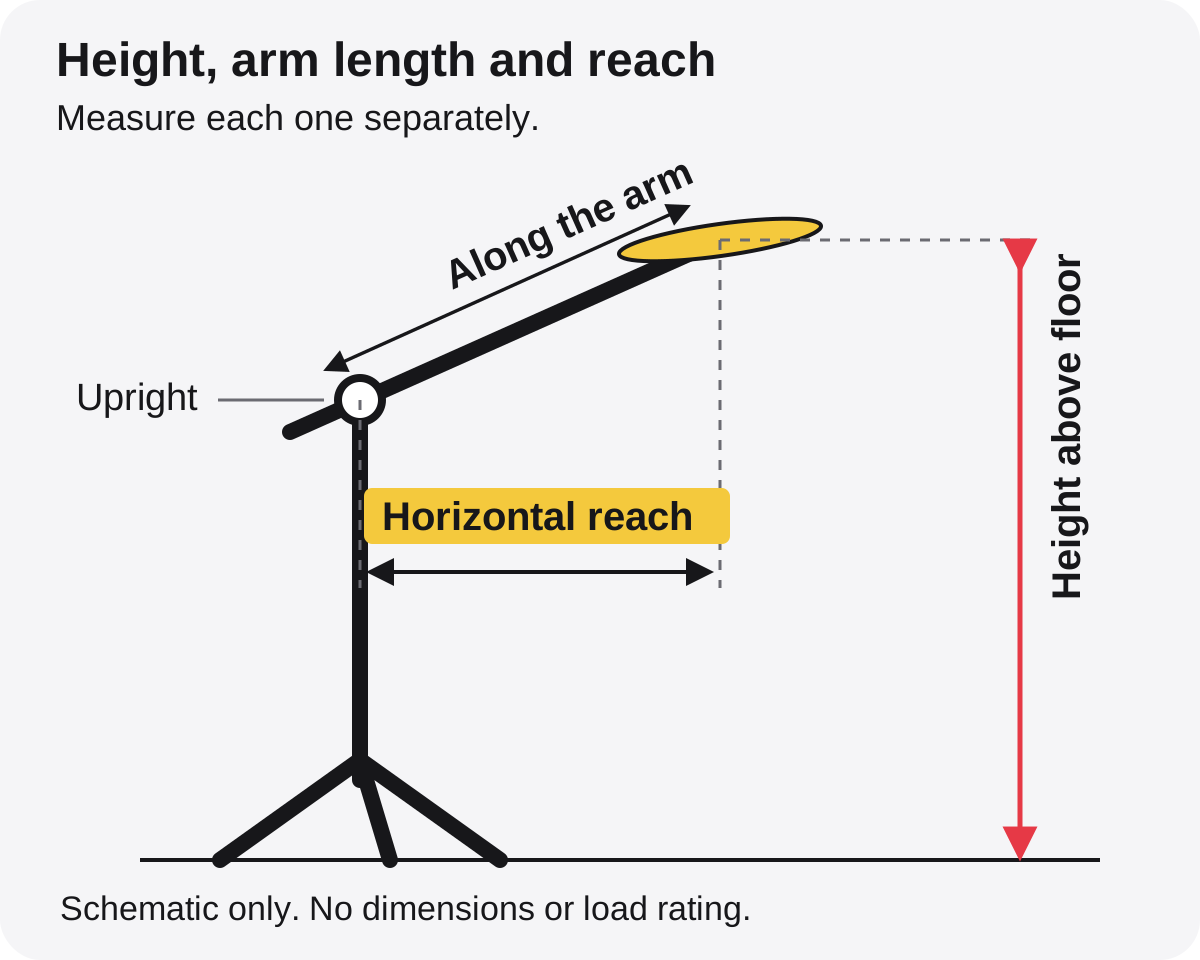
Schematic only. It separates floor-to-support height, horizontal offset, and length along the sloping arm; it does not show measured model dimensions or a safe load envelope. Arm angle and clamp engagement change usable offset.
Do not treat a maker’s maximum height and total arm length as permission to run both at their limits at the same time. The height measurement is one condition, and the arm position is another.
On the three boom-capable stands above, hideaway and convertible mean the same practical move: the boom stows into the upper tube so the stand works as a straight one for that section. The CS3 is the outlier; it reconfigures as a two-piece straight stand but has no boom section at all.
Leg bracing and floor clearance
Weigh the exact model and measure the opened leg spread around your hi-hat and pedals.
Gearless vs. geared tilters
A geared tilter moves in small indexed steps, which can give you repeatable positions but may stop one click short of the angle you imagined. A gearless tilter tightens continuously wherever you set it. Neither is inherently safer; on any geared design, mesh the teeth fully before tightening.
Set up safely around the boom
TAMA’s general hardware safety manual says to open the tripod wide enough, point one leg in the boom direction with the arm extended, support the upper section before loosening height or angle, and mesh gear teeth before tightening. That guidance is from TAMA’s general safety document, not a specific model manual for every stand here. Always follow your model’s instructions for approved extension, clamp engagement, and load limits. Placing one leg under the boom helps, but it is not a guarantee against tipping if the arm is overextended or the cymbal is unusually heavy. Don’t assume an extra tom, pad, or mic clamp is approved just because the stand can hold a single cymbal; verify the actual accessory or manual before adding clamps.
Protect the cymbal hole with the right sleeve and felts
The cymbal should never sit directly on exposed metal threads. Use the correct sleeve so the center hole is isolated from the shaft. Keep the supplied felts, support, and retainer assembled as the model instructions show, leaving the cymbal free to move slightly rather than clamping it rigid. A worn sleeve, missing felt, or wrong nut is a replacement-part issue. Before you buy a new stand, check whether the current one is serviceable with the correct small parts. Memory locks recall a position; they do not certify a load rating or prevent every slip.
Fit worksheet before you buy
Run through this blank check before choosing a model.
| Check | Your setup |
|---|---|
| Intended cymbal and mass if known | |
| Seated cymbal support height | |
| Proposed base position | |
| Horizontal offset needed | |
| Opened tripod clearance around hi-hat and pedals | |
| Model-approved extension and required sleeve/felts | |
| Collapsed length and bare mass vs. your bag | |
| Exact SKU, quantity, delivered total, return policy |
If you use a snare stand or hi-hat stand nearby, check how the opened legs overlap. Our hi-hat stand and snare stand buying guides cover adjacent floor clearance. For transport, compare the collapsed length and bare mass against our hardware bag guide.
Before you order
Measure your seated cymbal support height and the horizontal offset from the upright to the required cymbal support before ordering. Run the worksheet, then choose one of the four only if it fits that geometry. If your current stand is serviceable and the base can sit correctly, keep it.
Sources and limits
Manufacturer product and spec pages plus selected Amazon listing identities were checked on October 22, 2026. This article is research-led, not hands-on stability, durability, or listening tests.